IRATA International Level 3 Training: supervision, team leadership and advanced rescues for vertical work with maximum safety.

IRATA Level 3 International

IRATA International Level 3 Training: supervision, team leadership and advanced rescues for vertical work with maximum safety.

Proxima sesión :
No items found.
Total price:

Renewal: 950€

Initial or to level up: 1190€

Objectives

The IRATA Certification is the highest international accreditation in rope access work and its objective is to promote and develop an effective and safe work system through a code of good practices and a rigorous and periodic evaluation of both its members and training centers.

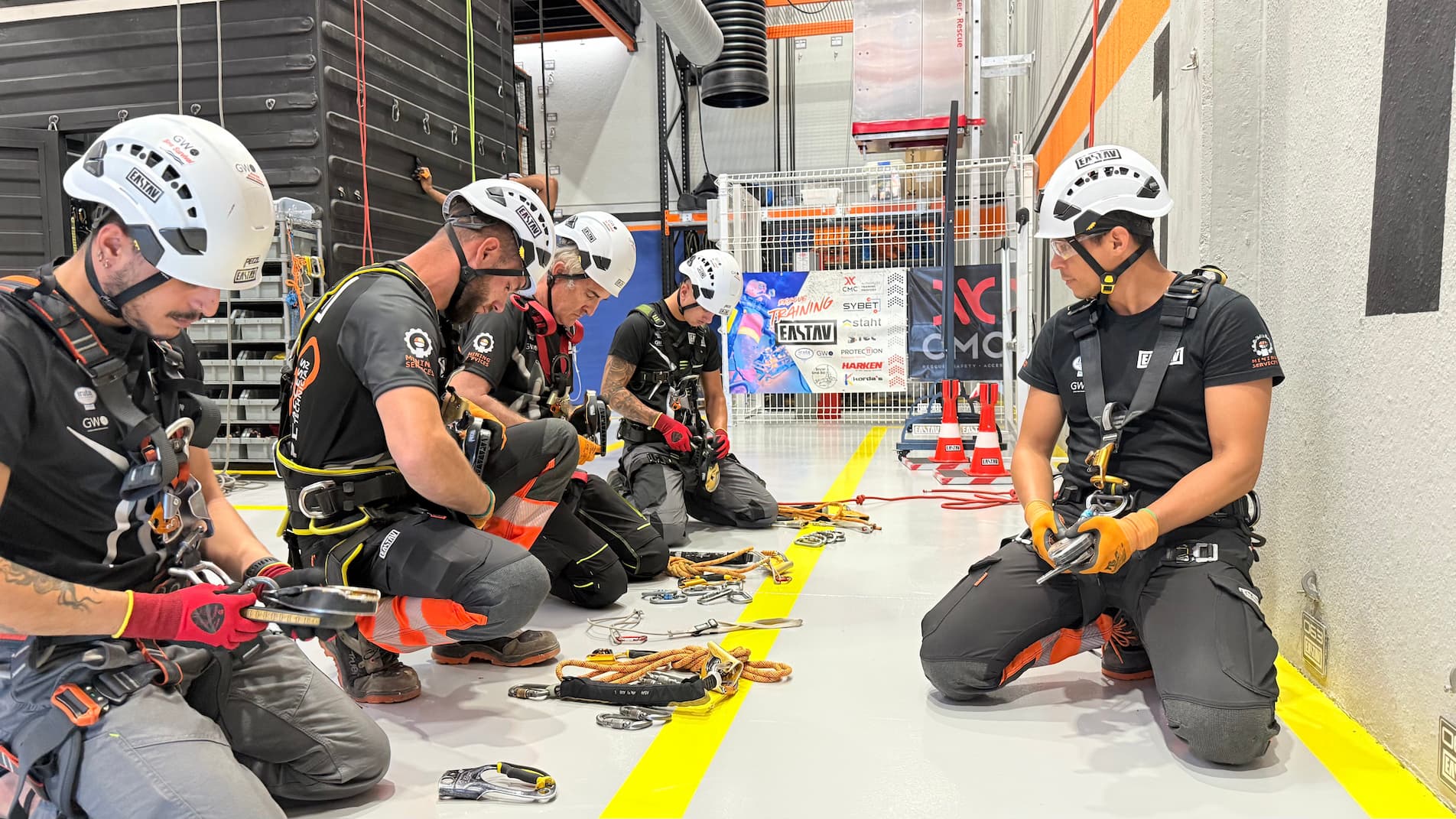
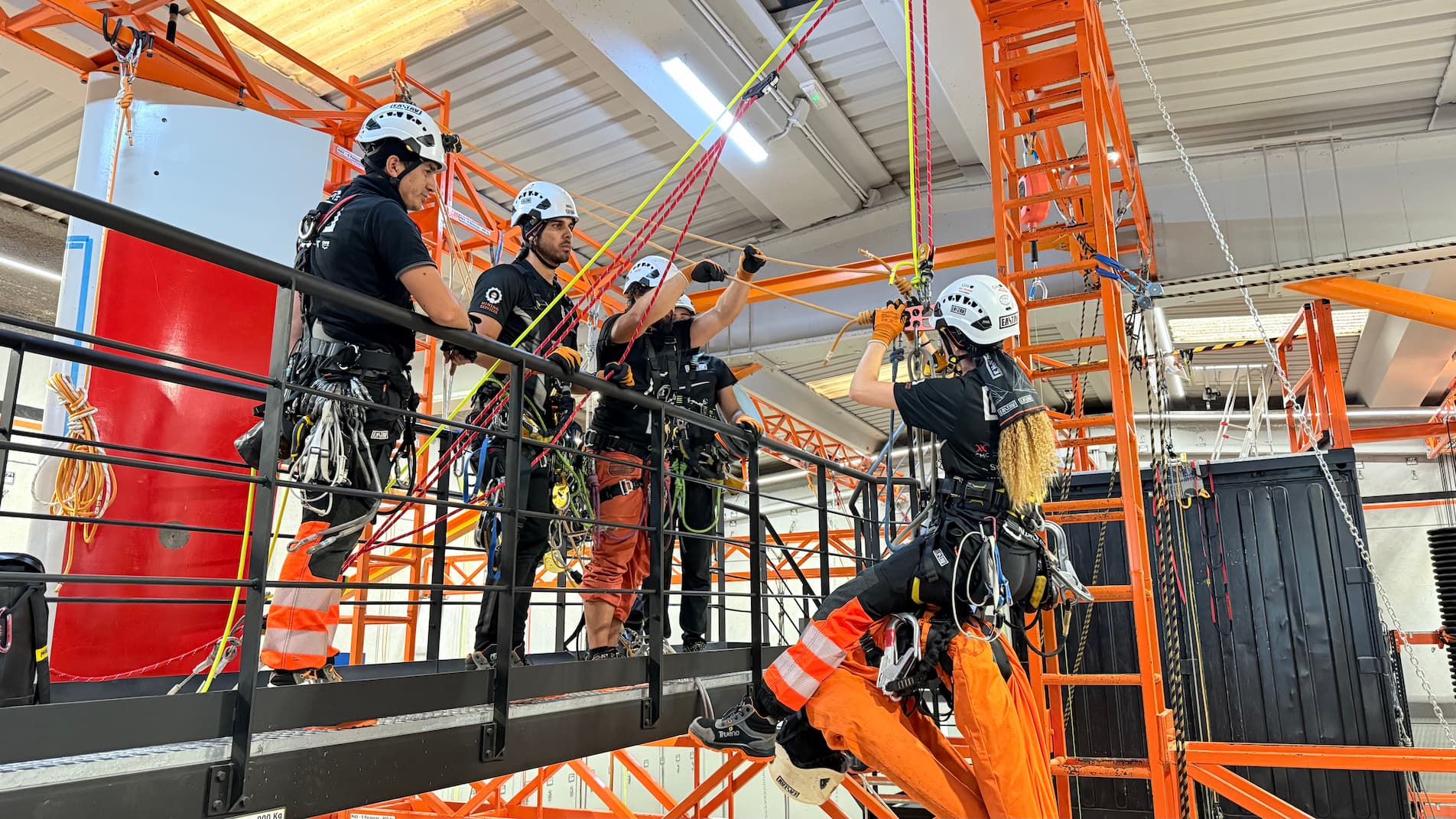
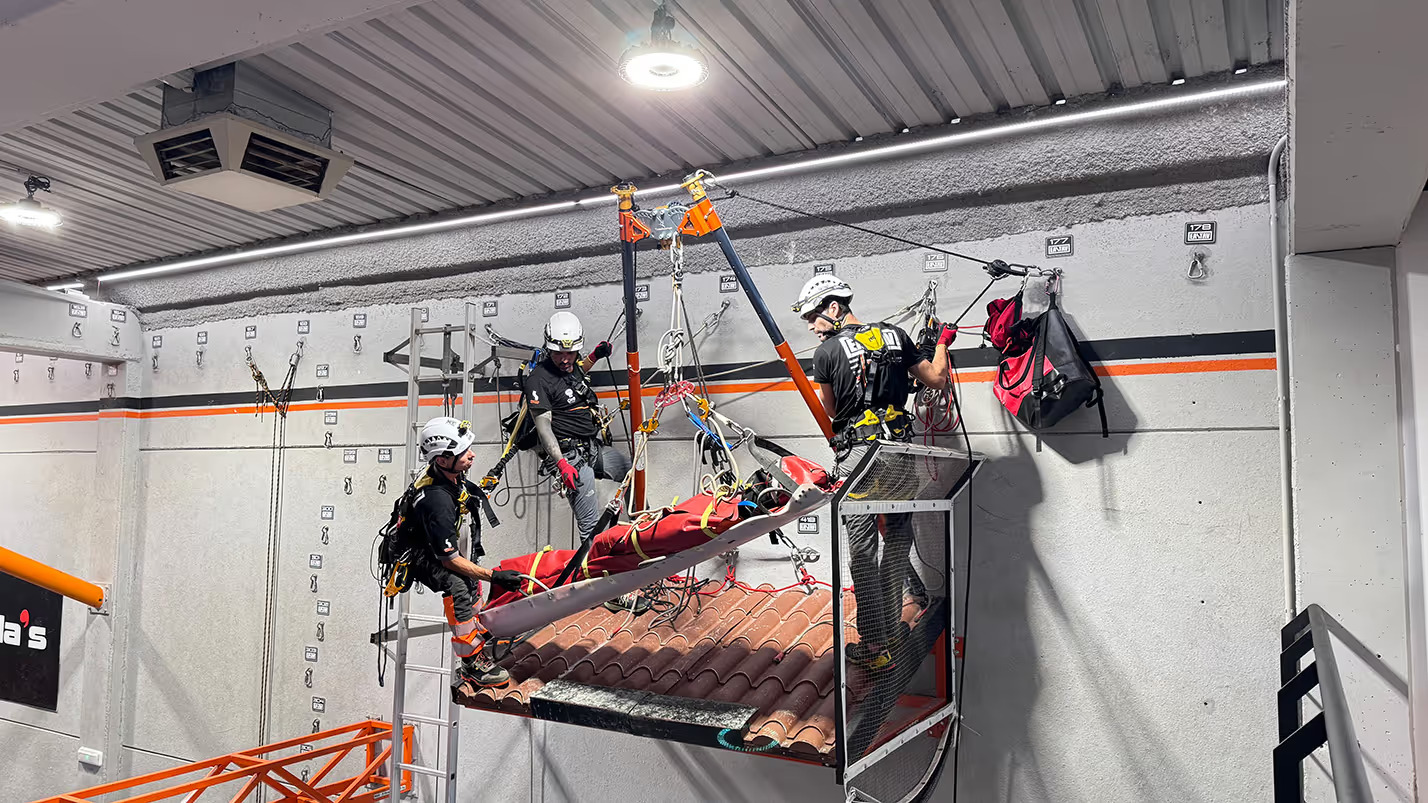
In our training, we try to let students know the main elements of safety and prevention so that they can organize the work activity in optimal conditions of performance and safety. It is also intended to train participants in rescue maneuvers and the correct use of related material.

Requirements:

  • Completed registration form.
  • Payment for the reservation or the entire course.
  • Level 2 accreditation must be in place
  • Completed and signed IRATA logbook correctly as marked on the last page of the same document.

With a minimum of 1000 hours in vertical work starting from the date of the last IRATA training completed and a minimum of one year of work since level 2 was completed, in total at least 2000 hours. (Both conditions must be met to level up)

Duration:

The duration of the course is 7 days + 1 exam day.

The IRATA standard requires a minimum of 4 days of training + 1 day of examination, so we are giving three more days of training.

Remark: Renewals can be made 6 months before or months after the current level is reached, in frequently asked questions you can find the steps to follow to recover your certification.

What are the minor discrepancies in the IRATA exam?

In the IRATA document “TC-101ESP Training Assessment and Certification Scheme (TACS)”, minor discrepancies that can occur during an evaluation are mentioned. Here are the details on the minor discrepancies: Minor Discrepancies 1. Definition: o Minor discrepancies are non-critical security issues caused by a candidate during the evaluation that compromise their safety or that of others, but are not considered to be a major threat. 2. Examples of Minor Discrepancies: o Inappropriate use of personal protective equipment, which does not put the candidate or others at immediate risk. o Technical errors that do not result in an immediate dangerous situation, but which indicate the need to improve certain skills or knowledge. o Lack of effective communication in teamwork situations, as long as it does not lead to a misunderstanding that jeopardizes safety. 3. Consequences: o Feedback and Correction: The evaluator will give immediate feedback on the minor discrepancy and request that the candidate correct the error. o Follow-up: These discrepancies are recorded and monitored to ensure that the candidate corrects them in future practices and evaluations. 4. Accumulation of Minor Discrepancies: o If a candidate accumulates several minor discrepancies during an evaluation, this can lead to a more detailed review of their competencies and, potentially, to the need for additional training before being re-evaluated. These minor discrepancies make it possible to identify and correct problems without compromising the candidate's certification, ensuring that all technicians maintain high standards of safety and competence in their activities.

How do I request a copy of my logbook, card or certificate?

You must write to the following email to request your duplicate directly from IRATA. registration@irata.org

What are the biggest discrepancies in the IRATA exam?

The IRATA “Training, Evaluation and Certification Scheme” (TACS) document details the discrepancies that may occur during an evaluation and that may lead to the termination or failure of the evaluation. The major discrepancies are summarized here: Major Discrepancies Compromised Critical Security: A larger discrepancy is a critical security issue in which the candidate puts himself or others at risk. This includes situations where the candidate acts in a dangerous manner or does not follow appropriate safety procedures. Termination of the Evaluation: The evaluation is terminated if a major discrepancy is made. Examples include, but are not limited to: Not using critical personal protective equipment. Perform dangerous maneuvers without adequate safety. Incorrect use of safety devices that could result in serious injury or death Exam Rules: Violating exam or evaluation rules, such as deliberately providing wrong answers or acting fraudulently, is also considered a major discrepancy. Other Critical Situations: Act to endanger one's own safety or that of others. Becoming abusive or threatening toward the evaluator or peers Refuse to comply with reasonable requests from the evaluator during the evaluation Consequences of Major Discrepancies Immediate Failure: The occurrence of a larger discrepancy results in an immediate failure of the evaluation. The candidate cannot continue with the evaluation and must receive additional training before being re-evaluated. Reevaluation: The candidate must undergo a reevaluation process after receiving additional training to correct the deficiencies identified during the initial evaluation. These strict measures ensure that only candidates who demonstrate a high level of competence and adherence to safety regulations can obtain and maintain IRATA certification.

Do I need experience to take this course?

To take the IRATA Level 3 course, it is necessary to meet certain experience and competence requirements, since it is the most advanced level in the IRATA (Industrial Rope Access Trade Association) certification scheme. Here are the main requirements: o Previous experience: You must have at least 12 months and 1000 hours of experience in rope access work documented and signed by a competent supervisor since your Level 2 certification. o Prior Certification: You must be certified as an IRATA Level 2 Technician. o Competence: You must demonstrate a high level of competence in rope access techniques, rescue and work supervision. o Theoretical and practical knowledge: You must have good theoretical and practical knowledge about safety, equipment and procedures for rope access. It's important to make sure you meet all of these requirements before enrolling in an IRATA Level 3 course. Training and certification are rigorous because of the hazardous nature of the job and the responsibility that comes with the advanced level.

Does this course help me to work anywhere in the world?

Yes, the IRATA (Industrial Rope Access Trade Association) certification is internationally recognized and allows you to work in many countries around the world. IRATA certification is highly valued in the rope access industry due to its rigorous training and safety standards. Here are some key points: o Global Recognition: IRATA certification is recognized by employers and authorities around the world, especially in the oil and gas, construction, building maintenance, and wind energy industries, among others. o Safety Standards: IRATA standards are considered to be the highest in the rope access industry, ensuring that certified technicians are competent and able to do their jobs safely and efficiently. o Employer Network: Many employers are looking for specifically technicians certified by IRATA because of the trust in the quality of the training and the competence of the technicians. o Documentation: By obtaining the IRATA Level 3 certification, you will receive a card and a certificate that are accepted in several countries and by numerous companies worldwide. However, it's important to note that some countries or companies may have additional specific local certification or training requirements. It's always advisable to check the specific requirements of the country or company where you plan to work to ensure that you comply with all necessary regulations.

How can I recover my Level 3 if it expires?

Level 3 Certification Retrieval 1. Expired Certification up to 6 Months: o Organize revalidation training with an IRATA TMC. o You must complete a minimum of 4 days of training before the evaluation for Level 3.2. Certification Expired Between 6 and 24 Months: o Organize a refresher course with an IRATA TMC. o Complete a 1-day refresher course, which must be recorded in your logbook and authenticated with the seal of the TMC or the signature of the instructor. o The TMC may charge for this course and authentication. 3. Certification Expired More than 24 Months: o You must organize a revalidation at Level 2 with an IRATA TMC. o Complete a minimum of 4 days of training before the evaluation for Level 2. o Once you have recovered your Level 2 certification, you must complete a minimum of 150 hours of work with rope access recorded after your most recent Level 2 evaluation, before attending a Level 3 training course. These procedures ensure that technicians keep their skills and knowledge up to date in accordance with IRATA standards. For more details, see IRATA's full TC-032ENG certification procedures document.

How long do I have to renew my IRATA certification?

Renewal Deadline 1. Validity Period: o The IRATA certification is valid for three years. You must renew your certification before this three-year period expires. 2. Renewal Window: o Revalidation evaluation and training can take place up to 180 days (6 months) before the certification expiration date without any time penalty. Steps for Renewal 1. Revalidation and Training: o You must complete a minimum of four days of training before the evaluation. This training must take place within the validity period of the certification or within 180 days prior to its expiration.

How to fill in the Logbook?

To complete the logbook, follow these steps as described in the training, evaluation and certification scheme document: 1. Technician Information: Each logbook must include information unique to the vertical work technician, such as the IRATA number and a photograph signed by the technician himself. 2. Supervisor's Signature: All entries in the logbook must be endorsed by a level 3 vertical rope technician supervising vertical work. This supervisor will record your name, signature and unique IRATA number. 3. Record Experience: Use the logbook to document experience and training. Annotations must be legible and made with a blue or black ink pen. 4. Job Details: Under the heading “Details of the task being performed”, describe the nature of the work, including the time spent rigging and disassembling ropes, inspecting equipment and talking about the toolbox. 5. Hours Worked: Record the hours worked directly on the contracted task. Don't include downtime, such as eating breaks or waiting time due to weather. 6. Maximum Worked Height: Under the heading “Maximum Worked Height”, it faithfully reflects the maximum height achieved during work. 7. Cumulative Total Hours: Under “Cumulative total hours worked”, add and record the hours transferred from the previous page to the “Total hours on this page”. By following these steps, you ensure that the logbook is complete and accurate, which is essential for maintaining certification and professional credibility.

¿Quién me puede firmar las horas del logbook?

Las horas del libro pueden ser firmadas por un técnico IRATA de Nivel 3, un director, gerente general o un gerente de acceso por cuerda. Este libro de registro debe ser presentado en el centro de formación al comienzo del curso cuando vayas a renovar o subir de nivel

¿Este curso también se realiza online?

No, el curso de IRATA no se realiza online. La naturaleza del trabajo de acceso con cuerda requiere una formación práctica intensiva y supervisada que no puede replicarse adecuadamente en un entorno en línea. Aquí están algunas razones por las que el curso debe realizarse de manera presencial: o Entrenamiento práctico: La mayoría de las habilidades y técnicas de acceso con cuerda deben practicarse físicamente bajo la supervisión de un instructor calificado. Esto incluye maniobras de rescate, técnicas de ascenso y descenso, y manejo de equipos. o Evaluación de competencia: Los instructores deben evaluar tu competencia en tiempo real para asegurarse de que puedes realizar las tareas de manera segura y efectiva. o Seguridad: La seguridad es una prioridad absoluta en el trabajo de acceso con cuerda. La capacitación práctica permite a los instructores monitorear de cerca a los estudiantes y asegurarse de que sigan los procedimientos de seguridad correctos. o Equipos especializados: La formación requiere el uso de equipos especializados que no están disponibles en un entorno en línea. Por estas razones, los cursos de IRATA, incluyendo el Nivel 3, se llevan a cabo en centros de entrenamiento autorizados donde se puede garantizar una formación adecuada y segura.

Total price:

Renewal: 950€

Initial or to level up: 1190€

Objectives

The IRATA Certification is the highest international accreditation in rope access work and its objective is to promote and develop an effective and safe work system through a code of good practices and a rigorous and periodic evaluation of both its members and training centers.

In our training, we try to let students know the main elements of safety and prevention so that they can organize the work activity in optimal conditions of performance and safety. It is also intended to train participants in rescue maneuvers and the correct use of related material.

Requirements:

  • Completed registration form.
  • Payment for the reservation or the entire course.
  • Level 2 accreditation must be in place
  • Completed and signed IRATA logbook correctly as marked on the last page of the same document.

With a minimum of 1000 hours in vertical work starting from the date of the last IRATA training completed and a minimum of one year of work since level 2 was completed, in total at least 2000 hours. (Both conditions must be met to level up)

Duration:

The duration of the course is 7 days + 1 exam day.

The IRATA standard requires a minimum of 4 days of training + 1 day of examination, so we are giving three more days of training.

Remark: Renewals can be made 6 months before or months after the current level is reached, in frequently asked questions you can find the steps to follow to recover your certification.

What are the minor discrepancies in the IRATA exam?

In the IRATA document “TC-101ESP Training Assessment and Certification Scheme (TACS)”, minor discrepancies that can occur during an evaluation are mentioned. Here are the details on the minor discrepancies: Minor Discrepancies 1. Definition: o Minor discrepancies are non-critical security issues caused by a candidate during the evaluation that compromise their safety or that of others, but are not considered to be a major threat. 2. Examples of Minor Discrepancies: o Inappropriate use of personal protective equipment, which does not put the candidate or others at immediate risk. o Technical errors that do not result in an immediate dangerous situation, but which indicate the need to improve certain skills or knowledge. o Lack of effective communication in teamwork situations, as long as it does not lead to a misunderstanding that jeopardizes safety. 3. Consequences: o Feedback and Correction: The evaluator will give immediate feedback on the minor discrepancy and request that the candidate correct the error. o Follow-up: These discrepancies are recorded and monitored to ensure that the candidate corrects them in future practices and evaluations. 4. Accumulation of Minor Discrepancies: o If a candidate accumulates several minor discrepancies during an evaluation, this can lead to a more detailed review of their competencies and, potentially, to the need for additional training before being re-evaluated. These minor discrepancies make it possible to identify and correct problems without compromising the candidate's certification, ensuring that all technicians maintain high standards of safety and competence in their activities.

How do I request a copy of my logbook, card or certificate?

You must write to the following email to request your duplicate directly from IRATA. registration@irata.org

What are the biggest discrepancies in the IRATA exam?

The IRATA “Training, Evaluation and Certification Scheme” (TACS) document details the discrepancies that may occur during an evaluation and that may lead to the termination or failure of the evaluation. The major discrepancies are summarized here: Major Discrepancies Compromised Critical Security: A larger discrepancy is a critical security issue in which the candidate puts himself or others at risk. This includes situations where the candidate acts in a dangerous manner or does not follow appropriate safety procedures. Termination of the Evaluation: The evaluation is terminated if a major discrepancy is made. Examples include, but are not limited to: Not using critical personal protective equipment. Perform dangerous maneuvers without adequate safety. Incorrect use of safety devices that could result in serious injury or death Exam Rules: Violating exam or evaluation rules, such as deliberately providing wrong answers or acting fraudulently, is also considered a major discrepancy. Other Critical Situations: Act to endanger one's own safety or that of others. Becoming abusive or threatening toward the evaluator or peers Refuse to comply with reasonable requests from the evaluator during the evaluation Consequences of Major Discrepancies Immediate Failure: The occurrence of a larger discrepancy results in an immediate failure of the evaluation. The candidate cannot continue with the evaluation and must receive additional training before being re-evaluated. Reevaluation: The candidate must undergo a reevaluation process after receiving additional training to correct the deficiencies identified during the initial evaluation. These strict measures ensure that only candidates who demonstrate a high level of competence and adherence to safety regulations can obtain and maintain IRATA certification.

Do I need experience to take this course?

To take the IRATA Level 3 course, it is necessary to meet certain experience and competence requirements, since it is the most advanced level in the IRATA (Industrial Rope Access Trade Association) certification scheme. Here are the main requirements: o Previous experience: You must have at least 12 months and 1000 hours of experience in rope access work documented and signed by a competent supervisor since your Level 2 certification. o Prior Certification: You must be certified as an IRATA Level 2 Technician. o Competence: You must demonstrate a high level of competence in rope access techniques, rescue and work supervision. o Theoretical and practical knowledge: You must have good theoretical and practical knowledge about safety, equipment and procedures for rope access. It's important to make sure you meet all of these requirements before enrolling in an IRATA Level 3 course. Training and certification are rigorous because of the hazardous nature of the job and the responsibility that comes with the advanced level.

Does this course help me to work anywhere in the world?

Yes, the IRATA (Industrial Rope Access Trade Association) certification is internationally recognized and allows you to work in many countries around the world. IRATA certification is highly valued in the rope access industry due to its rigorous training and safety standards. Here are some key points: o Global Recognition: IRATA certification is recognized by employers and authorities around the world, especially in the oil and gas, construction, building maintenance, and wind energy industries, among others. o Safety Standards: IRATA standards are considered to be the highest in the rope access industry, ensuring that certified technicians are competent and able to do their jobs safely and efficiently. o Employer Network: Many employers are looking for specifically technicians certified by IRATA because of the trust in the quality of the training and the competence of the technicians. o Documentation: By obtaining the IRATA Level 3 certification, you will receive a card and a certificate that are accepted in several countries and by numerous companies worldwide. However, it's important to note that some countries or companies may have additional specific local certification or training requirements. It's always advisable to check the specific requirements of the country or company where you plan to work to ensure that you comply with all necessary regulations.

How can I recover my Level 3 if it expires?

Level 3 Certification Retrieval 1. Expired Certification up to 6 Months: o Organize revalidation training with an IRATA TMC. o You must complete a minimum of 4 days of training before the evaluation for Level 3.2. Certification Expired Between 6 and 24 Months: o Organize a refresher course with an IRATA TMC. o Complete a 1-day refresher course, which must be recorded in your logbook and authenticated with the seal of the TMC or the signature of the instructor. o The TMC may charge for this course and authentication. 3. Certification Expired More than 24 Months: o You must organize a revalidation at Level 2 with an IRATA TMC. o Complete a minimum of 4 days of training before the evaluation for Level 2. o Once you have recovered your Level 2 certification, you must complete a minimum of 150 hours of work with rope access recorded after your most recent Level 2 evaluation, before attending a Level 3 training course. These procedures ensure that technicians keep their skills and knowledge up to date in accordance with IRATA standards. For more details, see IRATA's full TC-032ENG certification procedures document.

How long do I have to renew my IRATA certification?

Renewal Deadline 1. Validity Period: o The IRATA certification is valid for three years. You must renew your certification before this three-year period expires. 2. Renewal Window: o Revalidation evaluation and training can take place up to 180 days (6 months) before the certification expiration date without any time penalty. Steps for Renewal 1. Revalidation and Training: o You must complete a minimum of four days of training before the evaluation. This training must take place within the validity period of the certification or within 180 days prior to its expiration.

How to fill in the Logbook?

To complete the logbook, follow these steps as described in the training, evaluation and certification scheme document: 1. Technician Information: Each logbook must include information unique to the vertical work technician, such as the IRATA number and a photograph signed by the technician himself. 2. Supervisor's Signature: All entries in the logbook must be endorsed by a level 3 vertical rope technician supervising vertical work. This supervisor will record your name, signature and unique IRATA number. 3. Record Experience: Use the logbook to document experience and training. Annotations must be legible and made with a blue or black ink pen. 4. Job Details: Under the heading “Details of the task being performed”, describe the nature of the work, including the time spent rigging and disassembling ropes, inspecting equipment and talking about the toolbox. 5. Hours Worked: Record the hours worked directly on the contracted task. Don't include downtime, such as eating breaks or waiting time due to weather. 6. Maximum Worked Height: Under the heading “Maximum Worked Height”, it faithfully reflects the maximum height achieved during work. 7. Cumulative Total Hours: Under “Cumulative total hours worked”, add and record the hours transferred from the previous page to the “Total hours on this page”. By following these steps, you ensure that the logbook is complete and accurate, which is essential for maintaining certification and professional credibility.

¿Quién me puede firmar las horas del logbook?

Las horas del libro pueden ser firmadas por un técnico IRATA de Nivel 3, un director, gerente general o un gerente de acceso por cuerda. Este libro de registro debe ser presentado en el centro de formación al comienzo del curso cuando vayas a renovar o subir de nivel

¿Este curso también se realiza online?

No, el curso de IRATA no se realiza online. La naturaleza del trabajo de acceso con cuerda requiere una formación práctica intensiva y supervisada que no puede replicarse adecuadamente en un entorno en línea. Aquí están algunas razones por las que el curso debe realizarse de manera presencial: o Entrenamiento práctico: La mayoría de las habilidades y técnicas de acceso con cuerda deben practicarse físicamente bajo la supervisión de un instructor calificado. Esto incluye maniobras de rescate, técnicas de ascenso y descenso, y manejo de equipos. o Evaluación de competencia: Los instructores deben evaluar tu competencia en tiempo real para asegurarse de que puedes realizar las tareas de manera segura y efectiva. o Seguridad: La seguridad es una prioridad absoluta en el trabajo de acceso con cuerda. La capacitación práctica permite a los instructores monitorear de cerca a los estudiantes y asegurarse de que sigan los procedimientos de seguridad correctos. o Equipos especializados: La formación requiere el uso de equipos especializados que no están disponibles en un entorno en línea. Por estas razones, los cursos de IRATA, incluyendo el Nivel 3, se llevan a cabo en centros de entrenamiento autorizados donde se puede garantizar una formación adecuada y segura.

G google logo
He realizado el curso de trabajos verticales con EASTAV y la experiencia ha sido inmejorable. El equipo de formadores demuestra una gran profesionalidad y experiencia en el sector, explicando todo con claridad y asegurándose de que cada alumno adquiera las habilidades necesarias de forma segura.Las instalaciones y el material de práctica están en perfecto estado, lo que hace que el aprendizaje sea muy realista y completo. Además, el trato humano ha sido excelente: siempre atentos, cercanos y dispuestos a resolver cualquier duda.Sin duda, recomiendo EASTAV a cualquiera que quiera formarse en trabajos verticales con garantías y confianza.
Leer más
Silueta de una persona con los brazos levantados al atardecer con cielo despejado.
Claudio Pallares
G google logo
Superb experience.We came for the IRATA and GWO trainings expecting professionalism and high standards. I'm glad yo say that they surpassed our high expectations in every way.The premises are fully equipped with everything you need for your trainings, there's water supply, fridge and microwave for food, vending machine if you'd like a snack, a very appreciated and effective A/C (Stepping outside is like walking into the desert).Everyone is really professional and always eager to help, from the teachers to the cleaning staff. Everyone's great.Overall, a 10/10 experience, highly recommended.
Leer más
Icono de cara de calavera amarilla con expresión enfadada y cicatrices.
kike morales
G google logo
Me ha encantado las instalaciones pero lo mejor de todo.......el trato,la atención,todo el personal muy atento ,ayudándote y explicándote.Ya soy cliente y futuro alumno y por muchos años .
Leer más
Círculo azul grisáceo con una letra minúscula 'a' blanca en el centro.
antonio javier perez rico

Da tu próximo paso en trabajos verticales

Certificaciones oficiales, IRATA, GWO, FormacionesProfesionales, instalaciones de alto nivel y un equipo que te acompaña en cada paso.

Tabla de próximas sesiones de formación para diciembre 2025 con cursos GWO, IRATA y PRO, mostrando fechas, estado y plazas disponibles.

Próximas sessiones

Consulta el calendario actualizado de nuestras formaciones IRATA, GWO y PRL, con fechas abiertas y plazas disponibles. Elige la sesión que mejor se adapta a tu agenda y avanza en tu certificación con total confianza y planificación.

Calendario de las formaciones
Grupo de trabajadores con cascos y equipo de seguridad posando en una instalación industrial con logotipos de Eastav en la pared.
// JavaScript Document