.png)
Vertical Lifeline Specialists: Technical Guide to Standards EN 353-1 and EN 353-2
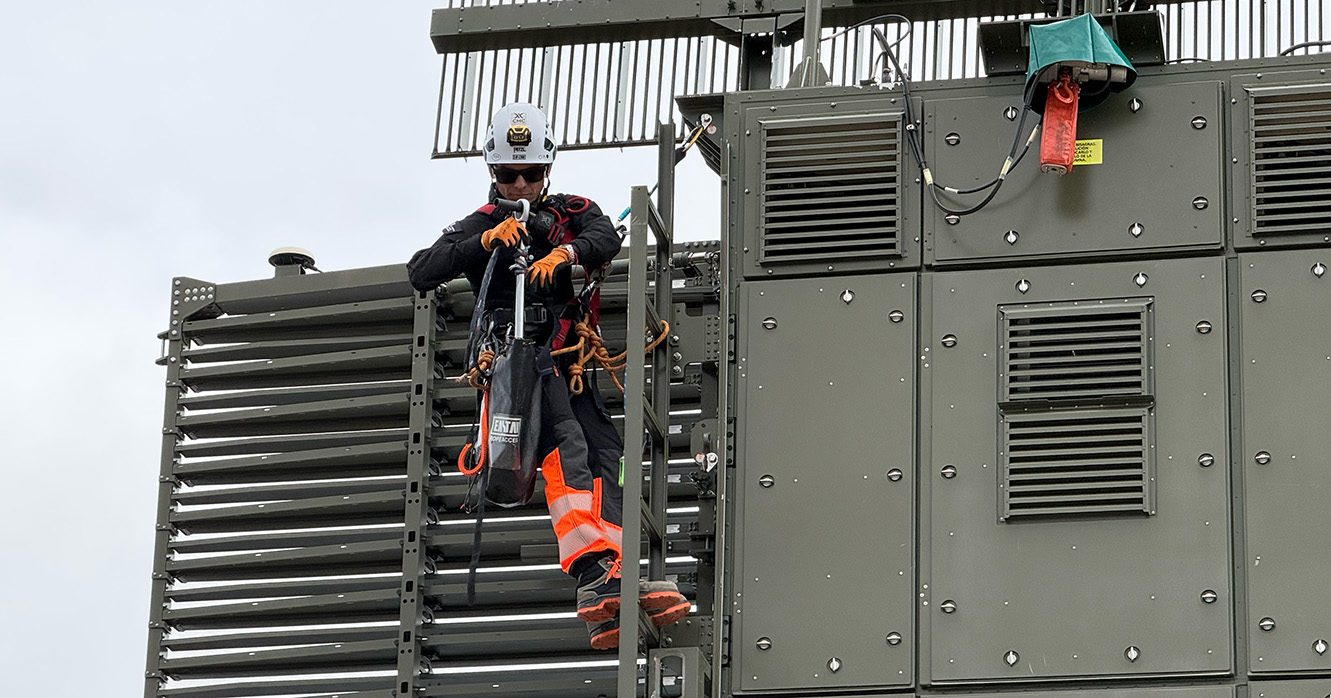

Climbing and descending vertical structures presents one of the highest risk indexes in work at height. Telecommunication towers, wind turbines, rung ladders, or chimneys are environments where a fall can be fatal — and where the safety solution must be as reliable as the access itself.
To ensure safe progression without hindering worker mobility, European regulations require the use of guided type fall arrest systems or vertical lifelines. At EASTAV GLOBAL, we specialize in their installation, and in this guide, we analyze in detail the two main regulatory groups that govern them: EN 353-1 and EN 353-2.
What is a Vertical Lifeline?
A vertical lifeline is an anchoring system designed to protect workers during ascent and descent on vertical structures. Unlike horizontal lines, the path is vertical, and the system must allow continuous progression — both up and down — without the worker having to disconnect at any point.
The system consists of two inseparable elements: the anchor line (rigid or flexible) and the guided type fall arrester (fall arrester trolley) that accompanies the worker and automatically locks in case of a fall.
Rigid Vertical Lifelines — EN 353-1 Standard
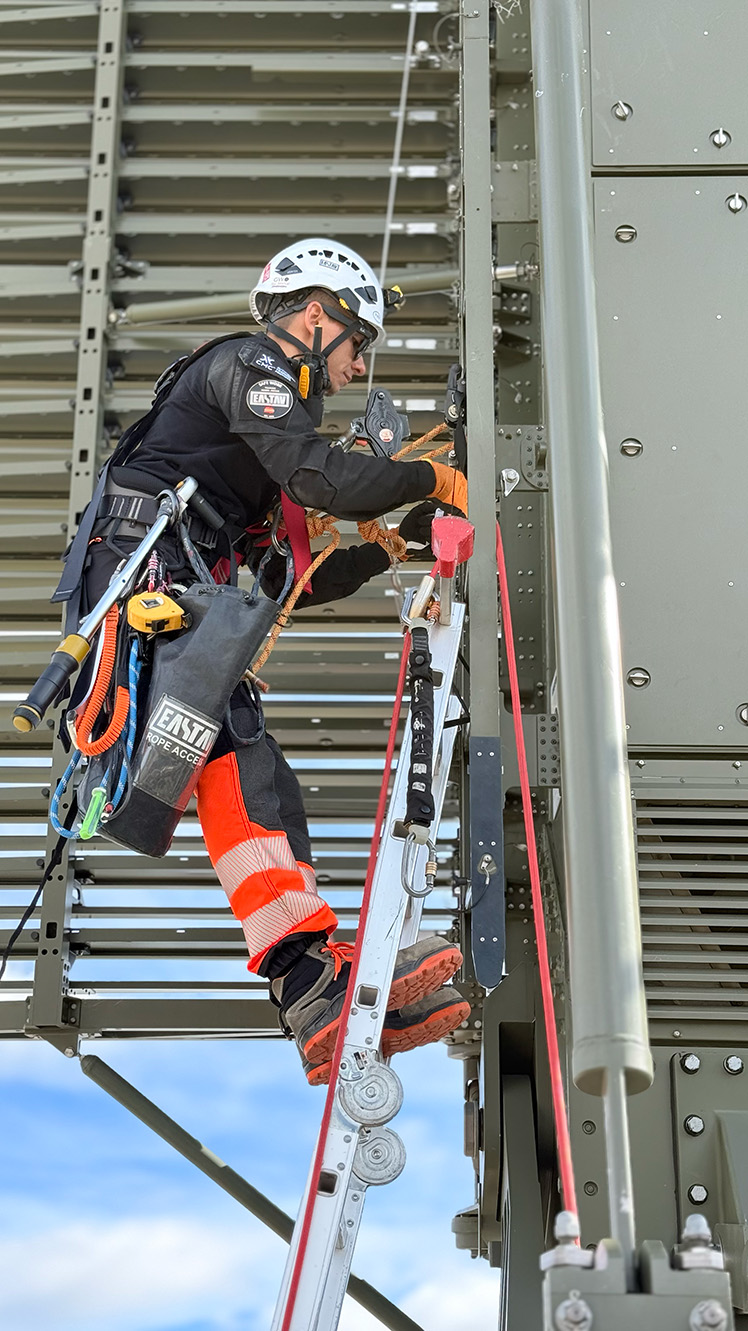
Systems certified under EN 353-1 are guided type fall arresters on a rigid anchor line. They are permanently installed along the ascent structure — typically integrated into the ladder rungs or parallel to them.
The operator connects to the line using a guided type fall arrester that slides freely during normal progression but locks instantly and automatically in case of sudden acceleration (a fall).
- Line Material: Aluminum or steel rail, or heavily tensioned steel cable guided every few meters to prevent vibrations and lateral displacement
- Main Uses: Cage ladders, rung ladders, wind turbines, telecommunication towers, and industrial chimneys
- Installation: Permanent and fixed to the structure
- Maintenance: Mandatory annual inspection by a certified installation company
%2520_%2520Reglamento%2520(UE)%25202016_425.avif)

Flexible Vertical Lifelines — EN 353-2 Standard
Systems certified under the EN 353-2 standard are sliding fall arrest devices on a flexible anchor line. Unlike rigid systems, the line is not structurally tensioned along its entire length — it is attached to a secure upper anchor point and hangs by gravity.
The worker uses a sliding device (known in the industry as a "rope grab") that accompanies their movement and locks upon detecting a fall.
- Line Material: Braided or semi-static ropes made of synthetic fibers (polyamide or polyester) or flexible steel cables
- Main Uses: Temporary work, scaffolding, pruning, rope access work, and sloped roofs with continuous ascent and descent
- Portability: High — the operator carries both the rope and the sliding device, installing and uninstalling them for each use
- Installation: Generally temporary and portable
%2520_%2520Reglamento%2520(UE)%25202016_425.avif)
Comparison: EN 353-1 vs EN 353-2
Legal Classification: Category III PPE (EU) 2016/425
Unlike fixed horizontal lifelines (which are construction products under UNE-EN 17235), the European Union considers vertical sliding fall arrest systems — both EN 353-1 and EN 353-2 — to be entirely Personal Protective Equipment (PPE).
As they protect against falls from height (a fatal risk or one that causes irreversible injuries), they are automatically classified as Category III PPE. To comply with Regulation (EU) 2016/425, these systems require:
- Tests successfully completed by an independent Notified Body (EU Type Examination)
- Rigorous production control through annual audits
- Visible and traceable CE marking on all equipment
The Principle of Inseparability: The Most Important Technical Detail
The most critical aspect that Regulation (EU) 2016/425 imposes on standards EN 353-1 and EN 353-2 is the principle of inseparability or joint certification.
The Regulation states that the guided type fall arrester (the shuttle) and the anchor line (the rail, cable, or rope) form a single PPE as a whole. This has a direct impact on site:
- It is completely illegal and unsafe to use the fall arrester shuttle from “Brand A” on the vertical lifeline from “Brand B”, even if the cable thickness appears to be the same
- The manufacturer certifies and issues the CE marking for the complete system that has been tested together
- Mixing brands is not permitted, nor are components not tested together
At EASTAV GLOBAL, we only install complete certified systems — shuttle and line from the same manufacturer, tested and certified together.
The Complete Fall Arrest Chain
A vertical lifeline never works alone. For its use to be legal and safe, it must be combined exclusively with the following PPE:
Legal Guarantee: Regulation (EU) 2016/425
All our vertical lifeline installations — both rigid (EN 353-1) and flexible (EN 353-2) — strictly comply with Regulation (EU) 2016/425.
The fall arrester trolley and the anchor line are tested, certified, and marketed as a single, inseparable system. We do not permit mixing brands or components that have not been tested together. We install safety equipment with European certification (CE Marking), guaranteeing that the equipment will infallibly stop your worker's fall.
Do you need to install a vertical lifeline?
At EASTAV GLOBAL, we conduct studies of your ladders and structures, supply the appropriate equipment, and install permanent solutions in strict compliance with regulations. Consult our lifeline installation page or contact us to assess the most suitable solution for your project.



Related professional teams
Certified material used and recommended by our technicians.
Train yourself for the most popular technical profiles
IRATA, GWO training and certified professional courses to access qualified, safe and recognized jobs in work at height and industry.