.png)
UNE-EN 17235 vs EN 795: What's changing in lifelines and anchors?
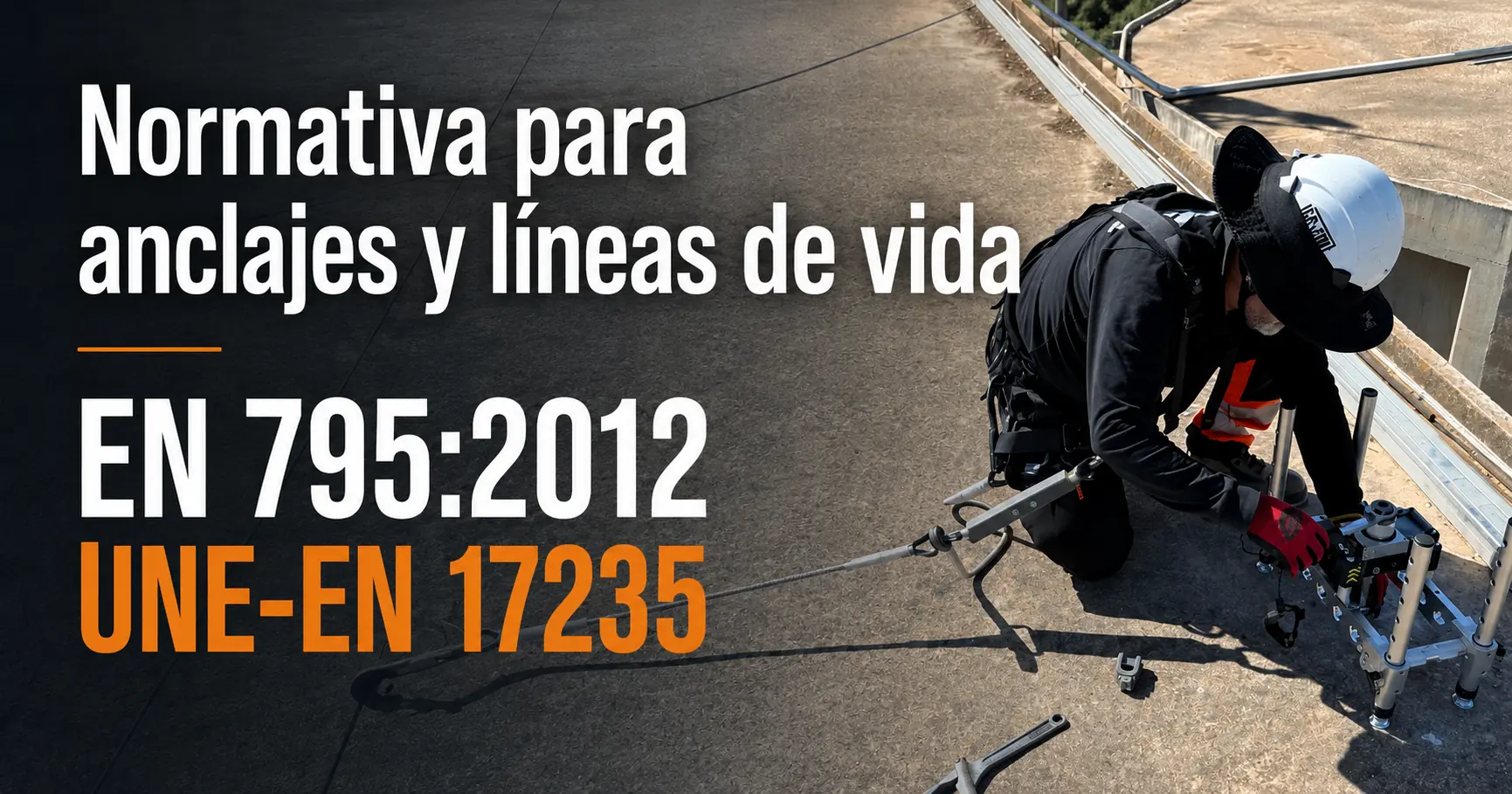

What changes with the new UNE-EN 17235:2025 and what is no longer covered by EN 795:2012?
The height safety and rope access sector is facing one of the most significant regulatory milestones of the last decade. The publication of standard UNE-EN 17235:2025 (official Spanish version of the European standard EN 17235:2024) categorically orders and redefines the design, testing, and commercialization of permanent anchor devices and safety hooks fixed in buildings and civil engineering works.
There is significant technical confusion in the market regarding whether the new standard completely replaces the classic EN 795:2012. In this comparative analysis, we meticulously break down what changes, what remains, and what falls strictly outside each regulatory framework.
1. Scope of Each Standard: The Core Distinction
The fundamental difference between both documents lies in the permanent nature versus the temporary or removable nature of the device, as well as its regulatory commercialization regime in the European Union.
- EN 795:2012: Its object and scope of application (Clause 1) are strictly limited to single-user anchor devices that are designed to be removable (withdrawn) from the structure. Permanent anchors and those intended for multiple users simultaneously fall outside its scope. As they are considered Personal Protective Equipment (PPE), they are governed by the PPE Regulation (EU) 2016/425.
- UNE-EN 17235:2025: Its purpose and scope (Clause 1) focus exclusively on anchor devices and safety hooks designed to prevent and arrest falls, permanently fixed in buildings and civil engineering works. As fixed components of the structure, they fall under the umbrella of the Construction Products Regulation (EU) No 305/2011 (CPR).
Technical warning: UNE-EN 17235:2025 expressly excludes temporary anchor devices compliant with EN 795:2012 in its Clause 1. They are not mutually exclusive, but rather coexist, clearly defining the boundary between a permanent construction product and a temporary/removable PPE.
2. From "Types" to "Kits": A new technical classification
The old classification by "Types" that we knew in EN 795 is transformed under UNE-EN 17235 into the concept of "Kits," evaluated in their entirety along with their fastening systems and support mock-ups.
- EN 795:2012 (Clause 3.2): Classifies as Type A (fixed point with structural anchor), Type B (provisional without structural anchor, such as tripods or slings), Type C (horizontal flexible line), Type D (rigid horizontal line) and Type E (deadweight/friction anchors).
- UNE-EN 17235:2025 (Clause 3.1): Introduces classification by Kits. A "Kit" includes the permanent anchor device or safety hook along with the fixing kit suitable for the load-bearing structure.
- Kit A: Permanent single anchor device
- Kit B: Permanent safety hook, also designed for attaching temporary roof ladders.
- Kit C: Flexible horizontal lifeline
- Kit D: Rigid horizontal lifeline
.png)
.png)
.png)
%202016_425.png)
%202016_425.png)
3. Comparative table: EN 795:2012 vs. UNE-EN 17235:2025
4. Critical differences in tests and acceptance values
Mechanical testing methods have undergone a revolution in the $2025$ standard to accurately replicate what happens in a real accident.
The concept of "Representative Mock-up" (Clause 5.1.1 and Table 6)
Under the EN 795:2012, devices were generally tested on rigid laboratory structures ($100\text{ Hz}$, Clause 5.2.2.1). In contrast, the UNE-EN 17235:2025 requires testing kits installed directly on mock-ups that replicate actual on-site supports. Table 6 defines with extreme precision the characteristics of these substrates for the worst-case scenario:
- Concrete (C): Minimum thickness of $100\text{ mm}$, strength class $C20/25$ to $C50/60$.
- Wood (T and W): Structural beams of class $C24$ ($60\text{ mm}$ thick) or boards of class $C14$ ($20\text{ mm}$).
- Trapezoidal steel sheets (STP50 and STP75): With limit thicknesses of $0.5\text{ mm}$ (non-structural) and $0.75\text{ mm}$ (structural), under standard EN 10346.
- Aluminum (ASS): Standing seam sheets with a thickness of $0.6\text{ mm}$ (EN 1999-1-4).
Limit and breaking values: Do not generalize the $27\text{ kN}$
It is a common misconception in the industry to state that all anchors must withstand $27\text{ kN}$. In the new UNE-EN 17235:2025, the value of $27\text{ kN}$ is the upper limit required in the Breaking Load Test for Kit C (Clause 5.5.4.4) and Kit D (Clause 5.6.4.4) where the test is increased "until the anchor system breaks or $27\text{ kN}$ is reached at the end anchors". It should not be extrapolated as a general static requirement for all components.
Furthermore, the limit deformation for Kit B (safety hooks) in its base test (Clause 5.4.2) is set at a strict threshold of $\le 5\text{ mm}$ after applying a static load of $1.5\text{ kN}$ for $5\text{ minutes}$.
5. Practical implications for industry stakeholders
For Manufacturers:
They must submit their permanent anchor lines and points to the Assessment and Verification of Constancy of Performance (AVCP) under System 1+ (Clause 6 and Annex ZA). This requires:
- Continuously audited factory production controls (FPC).
- Intervention by a Notified Body that will carry out initial inspections and sample testing (Clause 6.3.4).
- Mandatory issuance of the Declaration of Performance (DoP) and CE marking under the Construction Products Regulation.
For Installers and Competent Technicians:
It is no longer valid to justify a permanent installation based solely on an EN 795 Type A or C certificate. The compatibility of the Kit with the target support must be thoroughly checked (which must match or exceed the performance of the certified test mock-ups in Table 6). Every installation must be perfectly documented through a rigorous technical file that includes detailed photographic records of the anchors and fixings before they are covered by insulation or waterproofing layers.
Technical Conclusion
The regulatory landscape is clarifying: standard EN 795:2012 reverts to its original purpose (portable anchors, removable single-user PPE), while UNE-EN 17235:2025 assumes absolute control over all lifelines and fixed anchors in buildings under the European requirements of the CPR.
According to the official foreword of the European standard, all technically divergent national standards must be withdrawn by the end of June 2026. It is imperative that developers, designers, and user companies begin the transition towards specifying solutions tested as complete Kits under UNE-EN 17235.
Normative References Used:
- EN 795:2012 Standard Personal fall protection equipment - Anchor devices. (Clauses 1, 3.2, 5.2, 5.3, 5.4, 5.5).
- Standard UNE-EN 17235:2025 Permanent anchor devices and safety hooks. (Clauses 1, 3.1, 4.3, 5.1, 5.4.2, 5.5.4, 5.6.4, 6.3 and Annex ZA).
Do you need to adapt the safety of your facilities or acquire equipment that strictly complies with the new European regulations?
- Training and Certification: If you are looking for top-level training for your operators in rope access work under international safety standards, check out the IRATA Courses from EASTAV GLOBAL.
- Technical Equipment: Access the full range of approved anchors, connectors, and equipment in the EASTAV GLOBAL online store.
- Direct contact: Phones: +34 950 83 85 88 / WhatsApp: +34 625 24 19 94.
Kit Dinamómetro Ståht t25 Digital Pull Tester
- El kit Ståht t25 Digital Pull Tester es una herramienta esencial para profesionales que necesitan realizar pruebas de tracción en anclajes y pernos de seguridad de hasta 25 kN.
- La inspección y calibración es cada 12 meses y la realizamos en EASTAV -

Related professional teams
Certified material used and recommended by our technicians.
Train yourself for the most popular technical profiles
IRATA, GWO training and certified professional courses to access qualified, safe and recognized jobs in work at height and industry.