.png)

What is IRATA International: certification, levels, requirements and job opportunities

Work at height and rope access are part of industrial sectors where safety, technical precision and specialized training are essential. In this context, one of the most recognized and valued certifications globally is IRATA International.
Every year, thousands of professionals search the internet for information about What is IRATA, how to obtain certification, what levels exist and what job opportunities it offers. The reason is clear: having an IRATA certification opens the door to working on high-level industrial projects in different countries.
In this article you will discover What is IRATA International, what is certification for, what are its levels, who can be trained, how to advance professionally and what job opportunities it offers. In addition, you will learn what characteristics a quality training center should have and why EASTAV has become a benchmark in Spain for rope access training.
What is IRATA International
IRATA means Industrial Rope Access Trade Association, an international organization that establishes the highest standards of safety and training in rope access work.
Founded in the United Kingdom, IRATA has established itself as the global standard in industrial vertical work, used by companies around the world to perform tasks in hard-to-reach places.
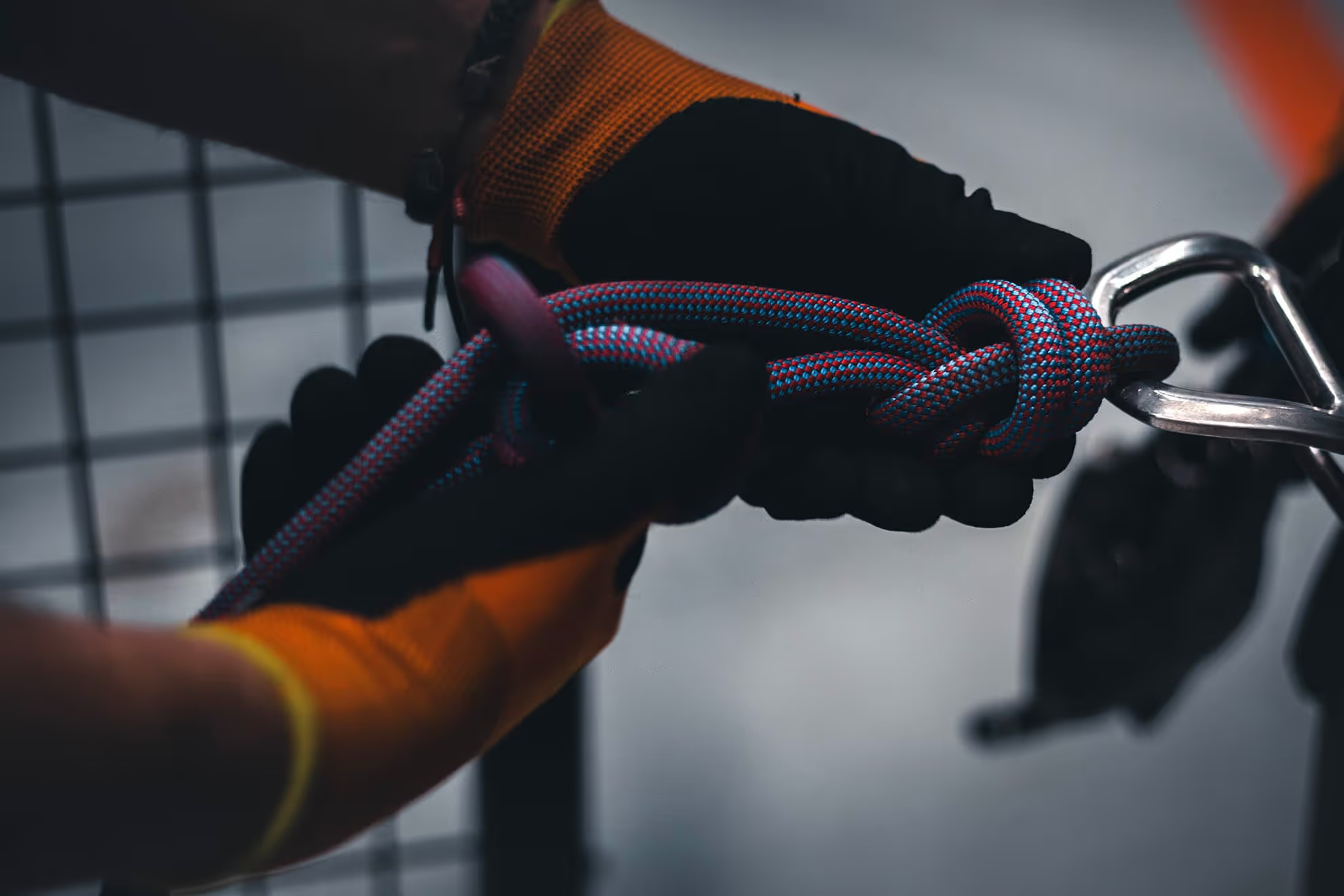
Rope access allows working at height safely, efficiently and with less impact on infrastructure, in many cases avoiding the use of scaffolding or lifting platforms.
Nowadays, IRATA certification is required or highly valued in sectors such as:
- Wind energy
- Oil and Gas
- Offshore industry
- Industrial construction and maintenance
- Telecommunications
- Infrastructure inspection
- Mining
- Industrial rescue
Thanks to their strict safety and training protocols, IRATA is considered to be one of the safest work systems at height in the world.
What is IRATA certification for
The IRATA certification proves that a professional has been trained and evaluated under the most demanding international standards in rope access.
Obtaining this certification allows you to:
1. Work on high-level industrial projects
Companies in sectors such as energy, oil, construction or industrial maintenance require certified technicians to operate at height.
2. Access international job opportunities
The IRATA certification has global recognition, which makes it possible to work in different countries and international projects.
3. Ensure safety standards
IRATA establishes strict procedures that ensure a highly secure work system, both for technicians and for companies.
4. Validate technical skills
The training and evaluation process certifies that the professional is proficient in:
- rope access techniques
- security systems
- Rescue at height
- risk management

What are the levels of IRATA certification
The IRATA system is structured in three progressive levels of certification, each with specific responsibilities and competencies.
IRATA Level 1
El Level 1 is the entry point for those who want to start their career in vertical jobs.
The IRATA Level 1 technician is qualified to:
- carry out rope access work under supervision
- use certified security systems
- execute basic tasks at height
- collaborate in rescue operations
It always works under the supervision of a Level 3 technician.
This level is ideal for those who want start a professional career in working at height.
IRATA Level 2
El Level 2 corresponds to technicians with more experience and advanced skills.
A Level 2 technician can:
- perform complex rope access maneuvers
- install work systems
- actively participate in rescue operations
This level involves greater technical responsibility and operational autonomy. The IRATA level 2 technician always works under the supervision of a Level 3 technician
IRATA Level 3
El Level 3 is the highest level within the IRATA system.
The Level 3 technician acts as operations supervisor and is responsible for the safety of the entire team.
Its functions include:
- planning work at height
- risk management
- supervision of Level 1 and 2 technicians
- design of rope access systems
- rescue coordination
IRATA Level 3 supervisors are highly qualified and highly sought after professionals in international industrial projects.
Who can take an IRATA course
One of the advantages of IRATA certification is that is not limited to a specific profession.
This training can be accessed by people from different sectors, such as:
- industrial technicians
- construction workers
- installers
- maintenance technicians
- professionals in the wind power sector
- offshore workers
- rescue specialists
- telecommunications staff
- people who want to change their professional sector
The most important thing is to have motivation, responsibility and ability to work in technical environments and at height.

Requirements for obtaining IRATA certification
To obtain IRATA certification, it is necessary to meet several fundamental requirements.
Adequate physical condition
Work at height requires good physical condition and ability to move.
Ability to work at height
It is important that the candidate Do not have medical limitations that prevent working at height.
Specialized practical training
The IRATA course is highly practical and allows you to develop real technical skills in controlled environments.
Evaluation by independent examiner
The final certification does not depend on the course instructor.
The evaluation is carried out by an independent examiner authorized by IRATA, which guarantees the objectivity of the process.
How to level up within IRATA
The progression within the IRATA system is designed to ensure that technicians gain real experience before assuming greater responsibilities. Therefore, advancing the level does not only depend on passing a course, but also on complying with minimum time requirements and working hours documented in the official IRATA logbook.
From IRATA Level 1 to IRATA Level 2
To access the course of IRATA Level 2, the technician must meet the following requirements:
- To have worked at least 12 months as an IRATA Level 1 technician.
- To have accumulated a minimum of 1,000 hours of actual work in rope access, registered in the IRATA logbook.
- All times must be verified and signed by an authorized supervisor or manager, usually an IRATA Level 3 technician.
These hours should correspond to real rope access jobs with double rope system, and do not include the hours of training completed during the courses.
From IRATA Level 2 to IRATA Level 3
To advance to Level 3, which corresponds to the IRATA supervisor level, additional experience is again required:
- To have worked at least 12 months as an IRATA Level 2 technician.
- To have accumulated Another 1,000 hours of work in rope access, registered and verified in the logbook.
Level 3 involves a much higher degree of responsibility, since these technicians are the ones who plan operations, monitor the equipment and ensure safety when working at height.
What characteristics should an IRATA training center have
Not all training centers offer the same level of quality.
Choosing the right center is key to getting solid and safe training.
A good IRATA center must have:
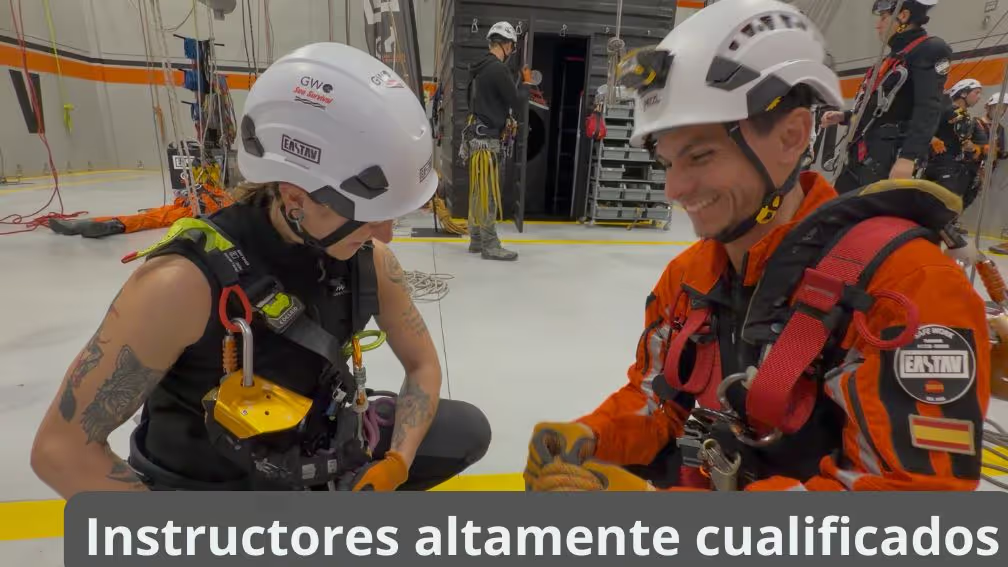
Certified and experienced instructors
Instructors must have real experience in industrial work at height.
Adequate technical facilities
It is essential that the center has structures that simulate real work environments.
Approved equipment
All material used must comply with international safety regulations.
Safety culture
IRATA training not only teaches techniques, but instill a professional culture based on safety.
Job opportunities for IRATA technicians
IRATA certification opens the door to numerous job opportunities in high-demand industrial sectors.
Among the sectors where IRATA technicians work are:
- wind energy
- industrial maintenance
- oil and gas
- offshore industry
- mining
- telecoms
- infrastructure inspection
- maintenance of bridges and buildings
- industrial rescue
Because of the specialization required by this type of work, certified technicians often have access to competitive salaries and international opportunities.
In addition, many professionals use this certification as basis for building a solid technical career in the industrial sector.
EASTAV: IRATA training center of reference in Spain and internationally
Choosing a good training center is a key decision for those who want to develop a career in rope access.
EASTAV has been consolidated as one of the most comprehensive technical training centers in Spain, located in Seville, offers training programs that not only meet international standards, but also they surpass them in quality and practical approach.
Learn more about EASTAV: IRATA Training Center.
Unique facilities for training in work at height
EASTAV's facilities have been designed to accurately recreate real industrial work environments.
We have unique facilities, adapted to any work environment, where students can train under conditions very similar to those they will find in real projects.
The center has:
- training areas at height
- specialized technical spaces
- practice areas with metal structures
- certified lifelines
- rescue simulators
Each zone is equipped with:
- professional lighting
- air conditioning systems
- certified anchor points
- state of the art materials
In addition, we have an outdoor area for motorhomes and technical vehicles, with access to water and electricity, designed for students traveling from other provinces.
In EASTAV GLOBAL, each space is designed for reproduce real working conditions in the industrial, vertical and rescue sectors.
Our center combines certified technical infrastructures with advanced simulation technology, creating a training environment unique in Spain.
Learn more about our IRATA training center in Seville and how to get there.
Financing courses with Instant Credit EASTAV
We know that technical training and professional equipment represent an important investment for many professionals.
For this reason, EASTAV offers EASTAV Instant Credit, a funding system designed to facilitate access to specialized training.
What Instant Credit EASTAV allows
With this system you can finance:
- IRATA courses
- GWO courses
- other technical specializations
- professional equipment
- combinations of courses and equipment
Advantages
- payments in 3, 6, 9 or 12 months
- Funding between 200€ and 2,500€
- Fees adapted to the student's budget
- quick and simple process
Requirements
To apply for EASTAV Instant Credit you need:
If you are a Spanish citizen:
- DNI
- active debit or credit card
If you are a resident in Spain:
- NIE
- active Spanish bank account
Get all the information about EASTAV INSTANT CREDIT
How payments work
Payments start 30 days after activation.
The charges are made automatically on the 1st of each month, which facilitates the student's financial planning.
How to book an IRATA course
If you are interested in training as a rope access technician, you can book your place in a simple way.
It's possible book online paying only 200€, ensuring your place in the course.
Check out the available courses here:
IRATA courses
https://www.eastav.com/categorias-de-formaciones/irata
You can also check the upcoming training dates in the calendar:
Course calendar
https://www.eastav.com/formacion/calendario-de-cursos
On the day of the start of the course you will be able Activate Instant Credit EASTAV to finance the rest of the amount, if you wish.

Related professional teams
Certified material used and recommended by our technicians.
Train yourself for the most popular technical profiles
IRATA, GWO training and certified professional courses to access qualified, safe and recognized jobs in work at height and industry.